
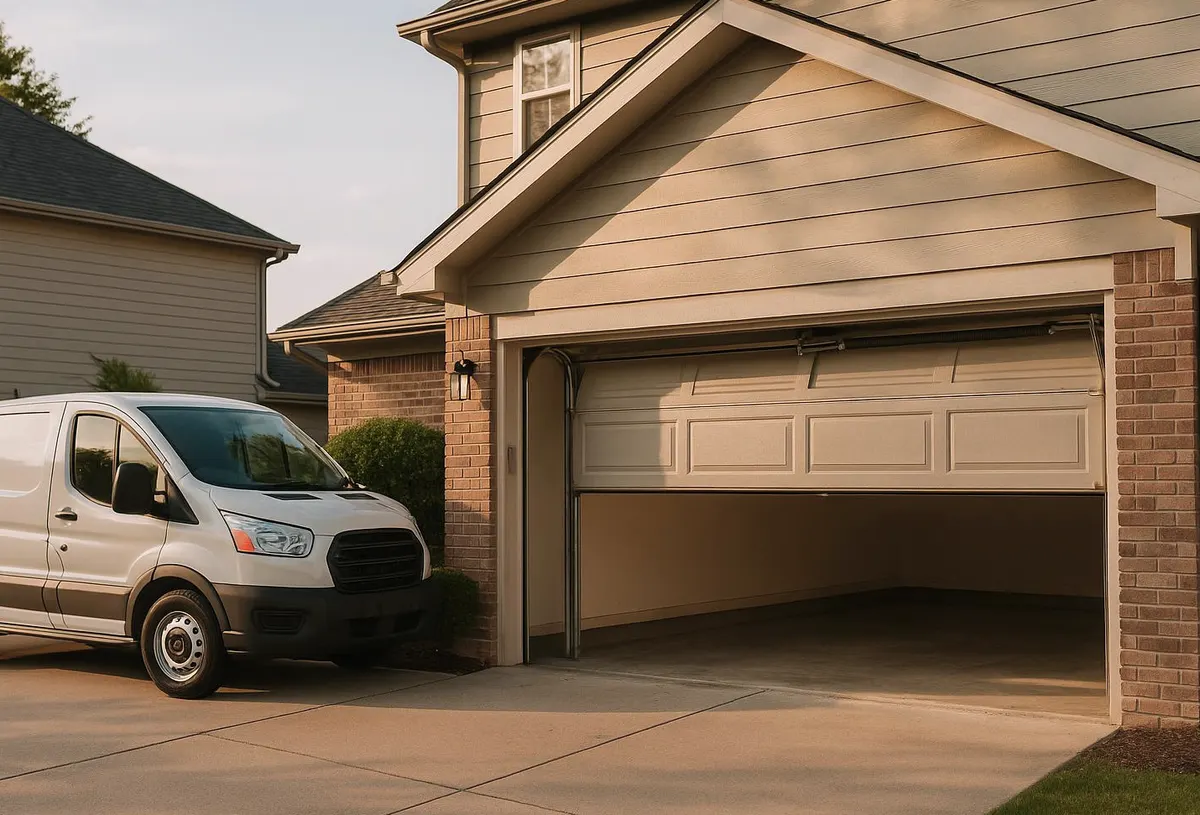
The Real Cost of Ignoring a Door That Won't Stay Shut
A garage door that reverses before it closes, or refuses to close at all, isn't a quirk to live with until spring. Every night it sits open, you're giving humid air, bugs, and anyone walking by a clear path into your garage. If you store tools, a second fridge, or holiday decorations out there, that moisture damage adds up fast in this climate. And if the problem is mechanical rather than electronic, every attempt to force it closed puts more strain on an opener motor that's already fighting something it shouldn't have to. What starts as an easy fix now can turn into a full opener replacement or a torsion spring that lets go unexpectedly later.
What You're Probably Seeing
- Door starts closing, stops a few inches down, and reverses back open
- Door reverses only when closing past the halfway point
- Door won't move at all when closing, but opens fine
- Opener motor hums or clicks but the door doesn't respond
- Door closes fine some days and reverses on others, often around the same time of day
That last pattern is a strong clue, and it points to where a technician would start looking.
What a Technician Checks, In Order
1. The Safety Sensors
This is the most common cause, by far. Every opener built in the last couple decades has two photo-eye sensors mounted low on each side of the track. If their line of sight is blocked, dirty, or misaligned, the opener assumes something is in the way and reverses the door as a safety measure. Afternoon downpours kick up dust and moisture that settles on the lenses, and direct sun at certain angles in late fall can trigger a false reading even with clean sensors. A technician checks the LED indicator on each sensor, wipes the lenses, and nudges the brackets until both lights glow steady instead of flickering. This takes minutes and solves the problem more often than any other fix on this list.
2. Opener Limit and Force Settings
If the sensors check out but the door still stops short or reverses partway down, the opener's close-limit setting may be off. Garage doors made of wood composite or steel with insulation can expand and contract slightly with humidity swings, which shifts how far the door needs to travel before it's fully seated. The fix is recalibrating the limit and force settings through the opener's learn button, then running several test cycles to confirm it holds.
3. Obstructions and Track Debris
Next, the track itself. Leaves, sand, and grit from storm runoff collect in the track over time, and rollers can start binding against it. Near the coast, salt air accelerates rust on the track rails and roller bearings, which adds friction the opener reads as resistance and reacts to by reversing. Cleaning the track and lubricating the rollers often restores smooth movement. If the track itself is bent or pulling away from the wall, that's a sign the door has gone off track at some point and needs realignment.
4. Springs Losing Tension
If the door won't close at all, or the opener strains and moves it in slow jerks, weakening springs are a likely culprit. Torsion and extension springs lose tension gradually, and humidity speeds up the corrosion that weakens them further. A spring under reduced tension changes how the door balances, which an opener's safety sensors can misread as an obstruction. Spring replacement is not a DIY repair, since these components are under heavy load, but it's a quick job for a technician and restores proper balance immediately.
5. Cables Fraying or Slipping
If one side of the door drops slightly before the other during closing, a cable is likely fraying or has slipped off its drum. This uneven movement is exactly the kind of thing that trips a reversal. Cable repair involves replacing the worn cable and re-tensioning both sides evenly.
6. Opener Circuit Board or Motor Issues
If every mechanical component checks out, the issue may be electrical, a failing circuit board or motor losing its grip on the gear. At that point, repair or replacement of the opener unit is usually the more reliable long-term fix.
When to Call Elfers Garage Door Repair
If you've wiped the sensors and the door still won't close, or if you can see a cable has slipped or a spring looks stretched or rusted through, stop testing it yourself and call us. We handle Garage Door Spring Repair and Garage Door Cable Repair regularly for homes across Elfers and Pasco County, and we'll diagnose which of these six points is actually causing the reversal rather than guessing. Call Elfers Garage Door Repair today and get your door closing properly before another storm rolls through.